Most people find out their irrigation system has a problem one of two ways: a brown patch that won't green up, or a water bill that jumped a hundred dollars. Both mean the system has been wrong for a while. Sprinkler systems are buried, run before you're awake and get taken for granted, so the trouble builds up unnoticed. Here are the six things we see most, roughly in the order they usually appear.
First, dry spots and brown corners while the rest of the lawn is fine. This is a coverage problem, and it's the most common call we get. Heads settle over time and end up spraying into the grass in front of them; a mower or an edger knocks one out of alignment; a shrub grows up and blocks the arc; or the system was never designed with head-to-head coverage in the first place. The fix is usually adjusting, raising or moving a few heads — cheap, and it makes a bigger difference to the lawn than any fertilizer.
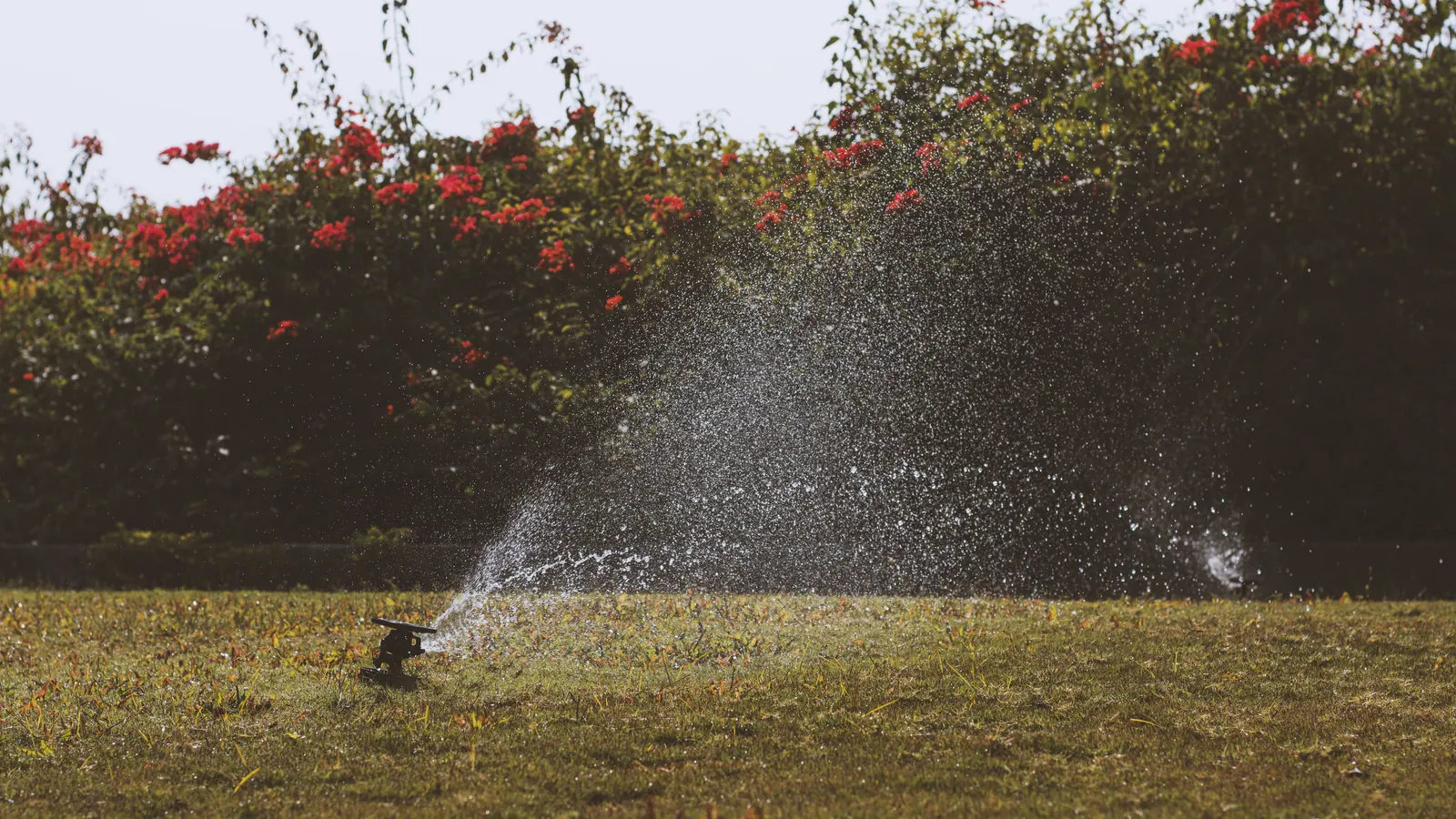
Second, a head that mists instead of throwing a stream. Misting means the pressure is too high for that head, and fine mist blows away and evaporates before it lands. The lawn under it is dry even though water is going out — you're paying for water the grass never gets. A pressure regulator at the valve or pressure-regulating heads solve it, and they usually cut the water bill in the process.
Third, a soggy patch or a constantly wet spot, especially near a valve box or at the lowest head in a zone. That's a leak — a cracked lateral line, a broken fitting, or a valve that isn't closing all the way and letting water seep out through the lowest head around the clock. Left alone it drowns the grass, invites fungus and can undermine a walk or a wall. If the spot is wet when the system hasn't run in a day, the valve is the suspect.
Fourth, a zone that won't come on, or won't shut off. A zone that stays off is usually a solenoid on the valve or a break in the wire to it; a zone that stays on is a valve stuck open, often by a grain of grit in the diaphragm. Both are quick repairs if the valve box can be found — and finding it is half the job on a system nobody has a map of. We locate valves, replace what's failed and leave you with a diagram.
Fifth, water pooling at the backflow preventer or a hissing at the meter. The backflow is the brass assembly near the street that keeps sprinkler water out of the drinking supply, and it's the part most likely to crack in a freeze if the system wasn't winterized. A leaking backflow runs whether the system is on or not. It's also the one component the county cares about, so repairs need the right parts.
Sixth, a controller nobody understands. Half the systems we see are on a schedule set by whoever installed them, watering every zone for the same ten minutes every day of the year. That's wrong in April and wrong in August, and it's the single biggest reason for high bills. A modern Wi-Fi controller with a rain sensor adjusts to the weather, waters deeply and less often, and can be run from your phone. Swapping the box is often the best money you can spend on the system.
A yearly tune-up — spring start-up, a run through every zone, heads adjusted, the controller reset for the season, and a winterization before the first freeze — catches all of this before it costs anything. If you've spotted one of these already, call Ga Panther Scapes at (404) 621-9107. We repair and install irrigation across Cumming, Alpharetta, Milton, Roswell and the surrounding area, and we'll give you a written price before we start digging.