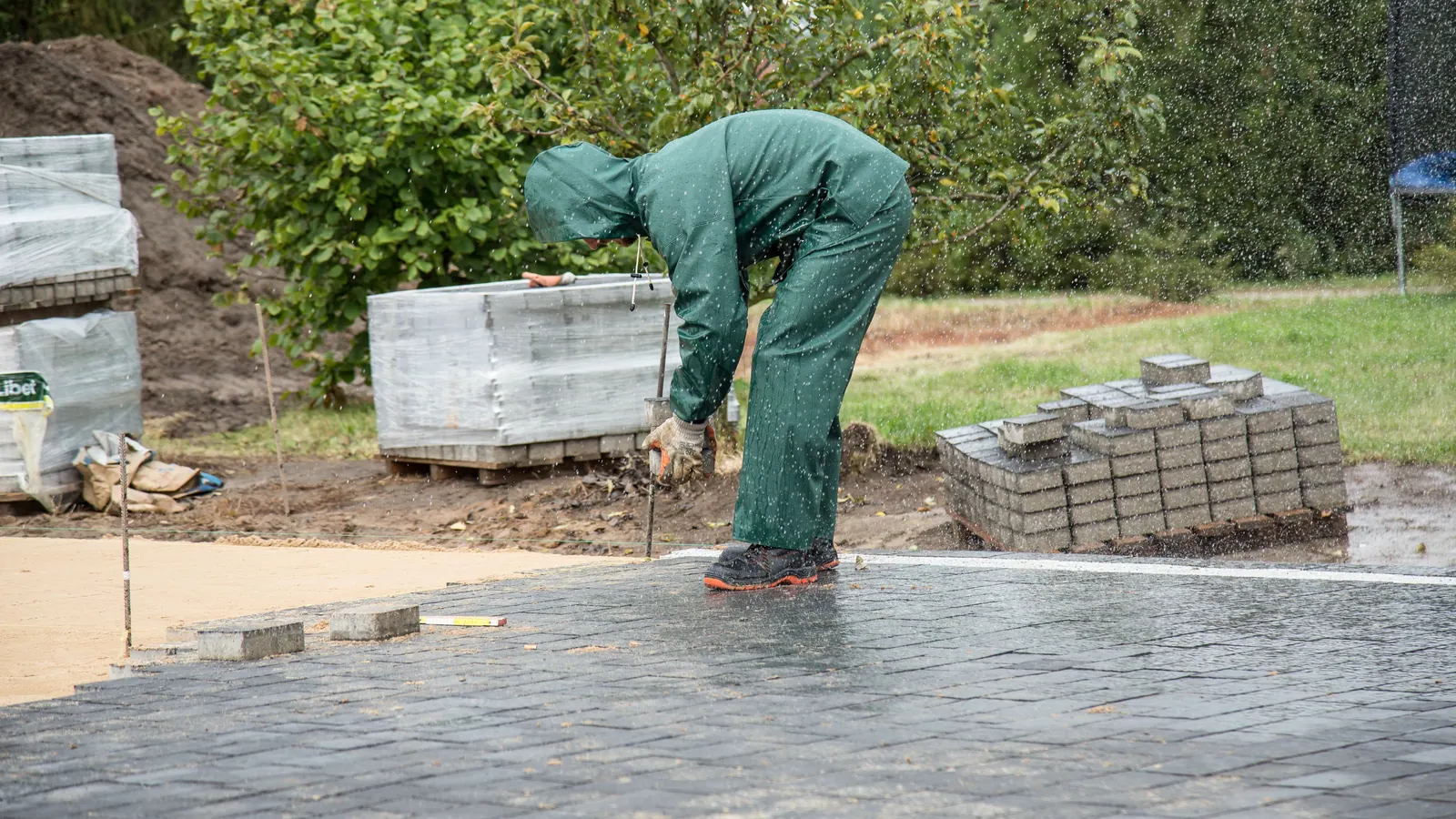
The most common hardscape call we get is some version of 'the patio the last guy built is sinking.' The pavers are fine. The pattern is fine. What went wrong is underneath: the pavers were laid on a couple of inches of sand over the ground as they found it, and the ground around here is red clay. Clay swells when it's wet and shrinks when it's dry, and it does both every year. Anything sitting on it moves with it. Here's how to plan a project so that doesn't happen to yours.
Start with the base, because it's the whole job. A patio or walkway that will last needs the clay excavated — six to eight inches for a patio, more for a driveway — and replaced with crushed gravel compacted in layers with a plate compactor until it's as hard as the pavers themselves. Then an inch of bedding sand, then the pavers, then edge restraint along every open side so the field can't spread. When you get quotes, ask how deep the excavation is and what the base is made of. If the answer is 'a few inches of sand,' keep looking.
Retaining walls have their own rule: drainage. A wall holds back soil, and wet soil is enormously heavier than dry. Every wall we build has a gravel backfill behind the block, a perforated drain pipe at the base carrying water out to daylight, and — above about three feet — geogrid reinforcement tied back into the slope. A wall built without those is a wall that leans within a few winters. Walls over four feet generally need an engineered design and a permit in most of the counties we work in, and that's worth knowing before you set your heart on a height.
Then think about water, because the whole project changes how it moves across your lot. A patio sheds rain that used to soak into the lawn; a wall interrupts a slope that used to drain to the street. Where does that water go now? Toward the house is the wrong answer, and it's the default if nobody plans for it. Good hardscape design grades surfaces away from the foundation, and where that isn't possible adds a French drain, a channel drain or a dry creek bed to carry water off. This is the part that saves you a wet basement, and it's cheapest to do while the ground is already open.
Materials are mostly a matter of taste and budget, with a few practical notes. Concrete pavers are the workhorse — consistent, strong, available in dozens of colors and patterns, and easy to repair one at a time. Natural flagstone is beautiful and irregular, costs more and takes more skill to lay flat. Poured concrete is the cheapest up front and the one that cracks, because it can't move with the clay the way a paver field can. For walls, segmental block is the standard; natural stone is the upgrade; pressure-treated timber is the budget option and has the shortest life.
Size the space for how you'll use it. A dining table for six needs about a twelve-by-twelve area to pull chairs out; a fire pit with seating around it wants a circle at least fourteen feet across; a walkway that two people can pass on is four feet wide, not three. Draw it on the lawn with marking paint and put the furniture on it before anyone digs. Most of the patios that turn out too small were sized by eye.
Finally, think about the sequence. Hardscape comes before landscape — walls, patios and drainage go in first, then the beds and plantings are built around them, then sod or seed repairs whatever the work tore up. Irrigation lines and any lighting or gas for a fire feature get run while the ground is open. Doing it in that order means nothing gets built twice.
If you're planning a patio, a walkway or a wall, that's exactly what the free estimate is for. Call Ga Panther Scapes at (404) 621-9107 and we'll come out, look at the lot and the slope, and give you a plan and a written price — in Cumming, Milton, Alpharetta, Roswell and the surrounding area.